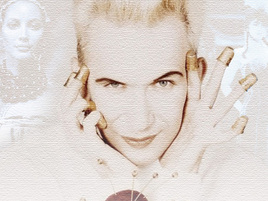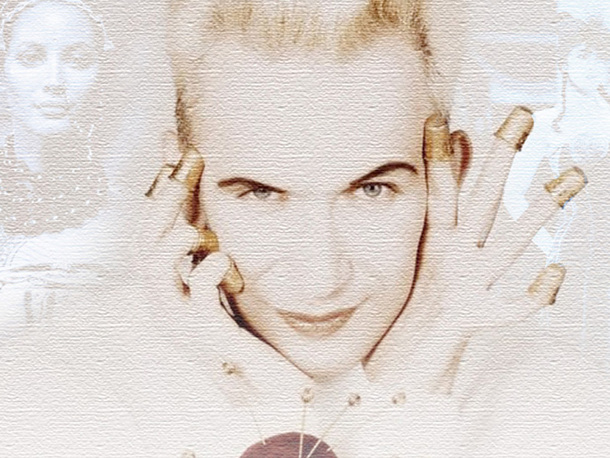
I’ve sat front row at more Gaultier shows than I can count, and even now, flipping through my old notebooks from the 70s, the sheer audacity of that first 1976 solo drop still makes my jaw drop. You had this 24-year-old kid, fresh off grunt work with Pierre Cardin, Jacques Esterel and Jean Patou, teaming up with Francis Menuge to thumb his nose at every stuffy 1970s Parisian fashion convention. It was a manifesto of irony and sartorial rebellion, plain and simple. Conservative critics screamed bloody murder. But that show laid the groundwork for every single code the brand still clings to today.
The Telnyashka That Launched a Thousand Subversions
Chief among those early codes? The Breton stripe. Forget the quaint nautical cliché you see on tourist postcards. Gaultier turned that humble striped shirt into a canvas for cultural ambivalence, full stop. His sailor wasn’t some wholesome deckhand hauling ropes on a fishing boat. No, this was a figure of rigid discipline warped by sharp, sexualized subcultural edge. Tight mesh that clung like fishing net. Lace-up knits that bit at the skin. Trompe-l’œil stripes that shifted from classic navy-and-white to psychedelic, body-distorting prints over the decades. Who could have predicted a utilitarian uniform would become a shorthand for unapologetic nonconformity? I sure didn’t, not back then.
Fragrance as Wearable Manifesto
Gaultier took his subversive streak to perfume long before every designer under the sun was churning out celebrity-endorsed scents as a quick cash grab. He dropped Classique first: a corseted female torso flask that was a straight-up riposte to the demure, ‘good girl’ fragrances clogging up department store shelves back then. Rum-infused rose, vanilla, ginger. It smelled like freedom, not submission. Then came Le Male in 1995, brewed by Francis Kurkdjian at Gaultier’s behest. Lavender, mint, vanilla, all poured into a flask shaped like a male torso in a striped telnyashka. It flew off shelves across Latin America and Southern Europe. A hyper-masculine scent flipped inside out, if you will. Gaultier was the first to treat packaging as part of the core creative concept. Ditch the boring cardboard boxes for metal tins. Turn flasks into sculptural objects you’d want to display on a shelf. That move paved the way for later flankers: Scandal, La Belle, Le Beau. All of them rooted in his lifelong obsession with corporeality and theater. I still have my original Le Male tin on my vanity, dinged up from years of travel.
Shattering the Gender Binary: Men in Skirts
Must a man’s wardrobe be shackled to centuries-old binary divides? Gaultier asked this outright in 1985, with his spring/summer line Et Dieu créa l'homme (And God Created Man). I remember that show—half the audience walked out, the other half cheered so loud the venue shook. For the first time, the men’s skirt wasn’t some ethnographic nod to Scottish kilts or samurai attire. It was a fully integrated, everyday staple. Some models played it safe with trousers and wide plaid wraps. But the message landed loud and clear: gender norms have no business in the dressing room. Gaultier kept coming back to the motif his entire career. The printed sarong David Beckham wore in the late 90s? That was his. The kilts he wore himself? Every cool guy from Ricky Martin to Marc Jacobs to Brad Pitt (in a 1999 editorial, no less) copied them. It was never about shock value. Never. It was always about giving people an alternative to rigid, arbitrary sartorial rules. You either got it, or you didn’t.
Nudity as Political Gesture, Not Spectacle
Gaultier’s androgyny experiments often brushed up against partial nudity, but it never felt gratuitous. Not once. For him, exposed skin wasn’t just erotic. It was a political, cultural, artistic act. Why should one gender get to bare their torso freely, while another gets censured for the same thing? That question took center stage in September 1992, when Gaultier walked the amfAR benefit show with Madonna, both in unitards with chest-baring cutouts. I was backstage that night—you could cut the tension with a knife. Nearly a decade later, spring/summer 2002: Naomi Campbell walked the runway shielding her bare chest with her hands. Carla Bruni wore a gown with a back so plunging it bordered on surreal. Gaultier spent decades erasing the line between body and garment. Between flesh and the stories we tell about it. He made you look at skin and see more than just a body.
Tattooed Garments: Skin as Narrative
The body as a blank canvas for storytelling had simmered in Gaultier’s work for years before it boiled over in his spring/summer 1994 Tatouage collection. Sheer tops, leggings, dresses—all printed with hyper-realistic tattoo motifs. Tribal patterns. Japanese and Slavic folk imagery. Old-school anchors, dragons, indigenous body art designs. All layered under gossamer mesh to mimic ink on skin. This wasn’t some empty celebration of subcultures. It was an attempt to give skin the weight of narrative. To stitch the marks of identity directly onto fabric. The motif popped up again in later couture collections, in uniforms for the Parisian cabaret Crazy Horse, even in a 2024 capsule drop that proved Gaultier’s tattooed codes are just as sharp now as they were three decades ago. I still have a Tatouage mesh top from that 1994 show, the ink print barely faded.
The Conical Bra: Lingerie as Armor
You know the one. The conical bra. Maybe Gaultier’s most iconic creation, it first popped up in his 1983 inaugural collection, but it cemented its place in pop culture lore when Madonna wore that sharp, architectural piece for her 1990 Blond Ambition tour. Gone were the soft, romanticized curves of mid-century lingerie. The corset’s pointed cones were a parody of traditional femininity—armor for a woman who refused to apologize for her desire. Gaultier loved telling the story of its humble origins: when he was six, he made a corset out of newspaper and string for his teddy bear Nana. A childhood experiment that redefined how the world viewed lingerie as outerwear decades later. It became a symbol of a new kind of womanhood. Aggressive. In control. Unapologetically sexual. I saw that Blond Ambition show in Paris—when Madonna hit the stage in that bra, the crowd went wild.
The Fifth Element: Couture for a Sci-Fi Future
1997 marked Gaultier’s first foray into blockbuster cinema: over 900 costumes for Luc Besson’s sci-fi epic The Fifth Element. His signature codes were all there, just rejiggered for a cosmic setting. Futuristic corsets. Plastic armor. Asymmetric cuts, bandages, exposed skin, hyper-trophied silhouettes. The standout? Milla Jovovich’s Leeloo. A minimalist white suit made of interlocking plastic strips that bared the body, serving as both armor and erotic fantasy. Tattoos, lingerie structures, uniform play—all his hallmarks, filtered through a lens of 23rd-century sexuality, hierarchy, corporeality. This wasn’t a prediction of future fashion. It was a cold, distant look back at our present-day norms. I took my niece to see that movie when it came out—she spent weeks drawing Leeloo’s suit in her sketchbook.
Sacred Iconography as Subversive Canvas
Gaultier never shied away from controversy, and nowhere was that clearer than his explorations of religious iconography. Autumn/winter 1993: the press called it ‘Rabbis Chic’ behind his back. Models in elongated black overcoats, fedora hats, peyes—remixing Hasidic dress codes with deconstructed womenswear. Spring/summer 1998 leaned hard into Christian imagery. Gowns with crucifixes, halos, nods to Renaissance Madonnas, made from tulle, guipure, velvet that clashed with exposed décolletage, midriffs, thighs. Then 2007’s couture collection Tribute to Religion went global: Buddhist robes, Catholic nun habits, Indian saris, East Asian priestess garments collided in a cosmopolitan pantheon. Critics were split right down the middle. Some called it a brave cultural collage. Others dismissed it as sacrilegious shock tactics. Does sacred imagery lose its meaning when stitched into a sheer evening gown? Gaultier never gave a straight answer. He just wanted you to ask the question. I got into a heated debate with a critic from Le Figaro about that 2007 show—we’re still friends, somehow.
Optical Illusions: Victor Vasarely and Trompe-l’œil Play
Gaultier pivoted to op art and geometric experimentation for his 1997 couture line Les Amazones, inspired by Hungarian op art pioneer Victor Vasarely. Hypnotic, geometric prints stretched and warped on fabric, elongating silhouettes, bending proportions, messing with the viewer’s perception. It built on the Tatouage collection’s themes, adding a layer of illusion. Gaultier went all in on trompe-l’œil: printing corsets, suspenders, even bare muscle onto dresses, knit sets, tops. An early iteration? A 1984 body with a printed muscle design. That code is still core to the brand’s DNA today, reinterpreted by guest designers in recent couture collections. I remember staring at that 1984 muscle print top for ten minutes straight, trying to figure out if the muscles were real or printed.
Boxing Masculinity: Hyper-Masculinity as Grotesque Theater
Men’s fashion was always Gaultier’s laboratory, and his autumn/winter 2011 collection turned the runway into a boxing ring. Models as fighters. Gone was the traditional macho archetype. These were bodies that faltered, blushed, exaggerated their strength until it tipped into grotesque. Muscles looked glued on. Faces had fake bruises. Gloves were purely theatrical, not sporting. Gaultier zeroed in on underwear: boxer shorts worn over trousers, padded crotches, exaggerated pouches. It was his lifelong theme, plain and simple: we don’t just put fabric on our bodies. We put society’s expectations on them, too. Critics were split. Some loved the theatricality. Others found the hyper-masculinity off-putting. That was the point all along. Gaultier never gave you a ‘correct’ version of manhood. Just a mask to examine. I walked out of that show feeling like I’d been punched in the gut—in a good way.
Passing the Torch: A Legacy That Refuses to Fade
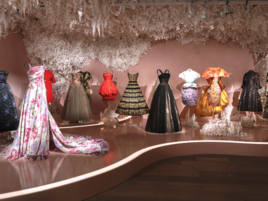
When Gaultier announced he was retiring from haute couture in 2020, he didn’t shutter the house that bore his name. No way. He pioneered a radical new model: every season, a guest designer would reinterpret the brand’s core codes. The lineup was a who’s who of modern fashion:
- Chitose Abe of Sacai
- Glenn Martens (Y/Project, Diesel)
- Olivier Rousteing of Balmain
- Haider Ackermann
- Julien Dossena of Paco Rabanne
- Simone Rocha
- Ludovic de Saint Sernin
Each designer stitched their own signatures into Gaultier’s legacy of corsets, tattoos, uniform play, gender fluidity. Ackermann’s take was poetic, minimalist. Rocha filtered his codes through Victorian femininity and distorted innocence. De Saint Sernin leaned hard into the house’s nautical roots. This experimental guest format ran until 2025, when the house got a new permanent creative director: Durand Lantink. He’s been stewarding the brand’s subversive spirit for a full year now, as Gaultier himself turns 74, watching from the sidelines with the quiet pride of a creator who left the door open for new voices. I met Lantink at a party last month—he’s got big shoes to fill, but he’s more than up to the task.